
Introduction: From a Single Cell to an Entire Ecosystem
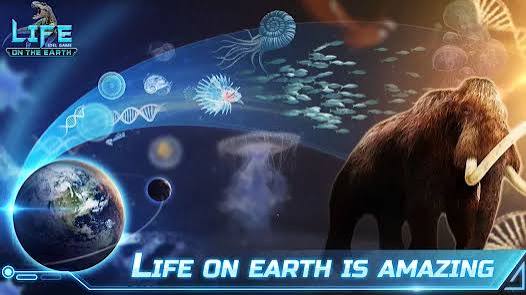
Imagine starting as nothing more than a microscopic organism floating in a primordial ocean, then slowly—through millions of virtual years—climbing the evolutionary ladder until you dominate the food chain. That is exactly the promise behind Life on Earth: Evolution Game, a mobile strategy–simulation title that blends idle-game mechanics with genuine evolutionary science. In this in-depth review, we will break down every layer of the experience, from core gameplay loops to visual polish, and help you decide whether this game deserves a spot on your home screen.
What Is Life on Earth: Evolution Game?
At its core, Life on Earth: Evolution Game is a free-to-play evolution simulator available on Android and iOS. Players begin at the very dawn of life on our planet—roughly 3.5 billion years ago—and guide organisms through geological eras, adapting to climate shifts, predators, and environmental hazards along the way.
The Core Premise
The game asks a deceptively simple question: Can you steer evolution and survive every extinction-level event? You start with a basic single-celled organism and unlock new traits, body plans, and habitats as you progress through the Cambrian Explosion, the Age of Dinosaurs, the Ice Ages, and beyond.
Genre Blend
Life on Earth sits at the intersection of several genres:
- Idle/incremental mechanics – Resources accumulate even while you are offline.
- Strategy simulation – Choosing the right mutations at the right time is critical.
- Educational sandbox – Real evolutionary concepts like natural selection, genetic drift, and speciation are woven into the design.
Gameplay Mechanics: How Does It Actually Play?
The Mutation System
Every few minutes of play, you earn DNA points—the game’s primary currency. These points let you purchase mutations such as sharper claws, thicker fur, venom glands, or even rudimentary wings. The catch is that each mutation carries trade-offs. Evolve a heavier shell for protection and your creature’s speed drops. This risk-reward structure keeps decision-making engaging rather than purely linear.
Eras and Biomes
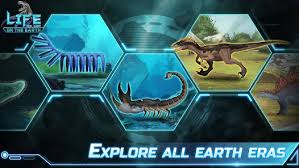
The game is divided into clearly defined eras, each introducing new biomes, predators, and climate challenges. Moving from the Cambrian seas to Jurassic forests, for example, forces you to re-evaluate your build. A creature perfectly adapted for deep-ocean pressure will struggle on land, encouraging players to diversify their evolutionary tree.
Offline Progression
True to its idle-game roots, Life on Earth continues generating resources while the app is closed. Returning after several hours to collect a backlog of DNA points creates a satisfying “reward loop” that many mobile players find hard to resist.
Boss Events and Extinction Challenges
At the end of each era, the game throws an extinction event—an asteroid impact, a volcanic winter, or a sudden sea-level drop. Surviving these scripted challenges requires you to have invested in the right adaptive traits beforehand, adding a layer of long-term planning to the otherwise relaxed pacing.
Graphics, Sound, and Presentation
Visual Design
The art style leans toward stylized realism. Creatures are not photorealistic, but they carry enough anatomical detail—segmented exoskeletons, feathered limbs, bioluminescent markings—to feel biologically plausible. Era transitions are accompanied by smooth environmental shifts: lush ferns give way to icy tundra, and the color palette adjusts accordingly.
User Interface
The UI is clean and intuitive. Mutation trees are laid out in a branching diagram that is easy to read even on smaller smartphone screens. Buttons are large, text is legible, and there is no clutter of unnecessary pop-ups during active play.
Audio and Music
The soundtrack shifts subtly with each era—ambient underwater tones in the Cambrian, drum-heavy tribal beats during the Stone Age, and sweeping orchestral swells during mass-extinction events. Sound effects for creature movements and environmental hazards are satisfying without being intrusive.
Progression, Monetization, and Fairness
Free-to-Play Structure
Life on Earth is free to download and play. Most progression gates can be cleared through patient play or by watching optional rewarded ads. Premium currency, called Amber, speeds up research timers and unlocks cosmetic skins for creatures.
Is It Pay-to-Win?
In short: no. The monetization model is gentle compared to many mobile titles. Paying players advance faster, but free players can access every era, creature, and mutation through time investment. No competitive PvP mode exists, so there is no pressure to outspend other players.
Long-Term Content Depth
The developers regularly push updates that add new creature lines, side-biomes, and limited-time events. As of 2026, the game includes over 200 unique organisms and 12 major geological eras, offering roughly 40–60 hours of guided content before players enter the open-ended “endless evolution” sandbox mode.
Strengths and Weaknesses
What the Game Does Exceptionally Well
- Educational value – Evolutionary concepts are presented organically, never feeling like a textbook lecture.
- Strategic depth – Mutation trade-offs prevent a single “best build,” encouraging experimentation.
- Polished visuals – The stylized art direction ages gracefully and runs smoothly on mid-range devices.
- Respectful monetization – No aggressive energy timers, no loot boxes, no mandatory ads.
Where It Falls Short
- Repetitive mid-game – Between eras 5 and 8, the core loop of “earn DNA → buy mutation → face event” can feel formulaic.
- Limited social features – There is no co-op mode, leaderboards are basic, and community interaction is minimal.
- Occasional balancing hiccups – A few mutations in later eras are noticeably overpowered, reducing the challenge ceiling.
- Storage footprint – The game exceeds 1.2 GB on mobile, which may be a concern for users with limited space.
Who Should Play Life on Earth: Evolution Game?
| Player Type | Verdict |
|---|---|
| Fans of idle/incremental games | Highly recommended |
| Biology and nature enthusiasts | Highly recommended |
| Casual mobile gamers seeking depth | Recommended |
| Hardcore strategy gamers | May find pacing too slow |
| Players seeking multiplayer competition | Look elsewhere |
If you enjoyed titles like Cell to Singularity, Plague Inc., or Spore, Life on Earth will feel immediately familiar yet distinct enough to warrant your time.
Tips for New Players
- Diversify early. Do not pour every DNA point into a single trait line; balanced organisms survive extinction events more reliably.
- Save Amber for era transitions. The difficulty spike between eras is where premium speed-ups matter most.
- Read mutation tooltips carefully. Hidden stat penalties can undermine an otherwise strong build.
- Log in daily for streak bonuses. Consecutive-login rewards compound quickly and keep your progression smooth.
- Experiment in sandbox mode. Once you finish the main timeline, the endless mode lets you create hybrid creatures without consequence.
Final Verdict: Is Life on Earth Worth Your Time?
Life on Earth: Evolution Game succeeds where many educational-simulation hybrids fail—it makes learning genuinely fun without sacrificing strategic depth. The mutation system is clever, the era-based structure provides a clear sense of progress, and the respectful free-to-play model means you never feel nickel-and-dimed.
Its mid-game repetition and lack of robust multiplayer features keep it from reaching absolute perfection, but for a solo mobile experience that rewards curiosity, patience, and thoughtful planning, this is one of the strongest evolution games currently available.
Rating: 8.2 / 10
Whether you are a casual player looking for a relaxing idle title or a science nerd who wants to watch natural selection unfold on a touchscreen, Life on Earth: Evolution Game offers a surprisingly rich journey from primordial soup to apex predator. Give it a download, pick your first mutation, and let millions of years of virtual evolution unfold at your fingertips.
Have you already tried Life on Earth: Evolution Game? Share your favorite creature build or the extinction event that gave you the toughest time in the comments below.
Download Life on Earth from Google Play for Android:
Download for Android, click here